


Test Your Courage Challenge in Chicago: Date and Times
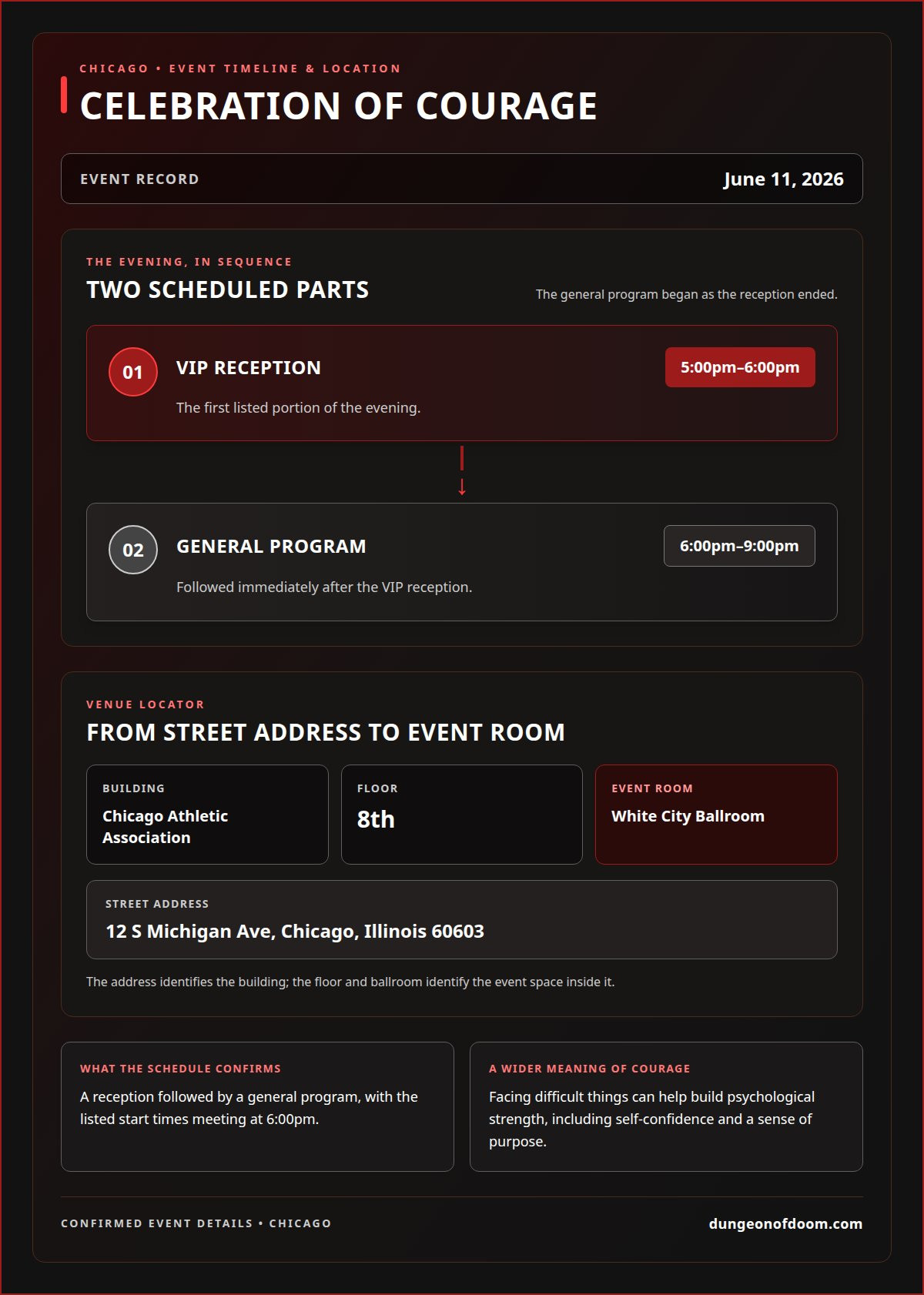
Courage isn’t proven by standing untouched in the dark. The 2026 Celebration of Courage, a Chicago event for anyone seeking a test your courage challenge in Chicago, was held on June 11. The VIP reception ran from 5:00pm to 6:00pm, followed by the general program from 6:00pm to 9:00pm at the White City Ballroom on the 8th floor of the Chicago Athletic Association, 12 S Michigan Ave, Chicago, Illinois 60603.
Facing something difficult can mean moving forward while fear is still there. Psychology Today describes doing difficult things as one way to build psychological strength, including self-confidence and a sense of purpose. Courage isn’t always a dramatic act; it can also emerge when you meet discomfort instead of turning away.
Here, you’ll find the Chicago event details and a clearer sense of what courage can mean beyond a test of nerves. The schedule and venue provide practical information, while the ideas behind courage offer another way to think about facing a challenge.
Table of Contents
Event date, times, and venue in Chicago
The 2026 Celebration of Courage took place on June 11 in Chicago. Its schedule had two consecutive parts: a VIP reception from 5:00pm to 6:00pm, followed by the general program from 6:00pm to 9:00pm. The venue was the White City Ballroom on the 8th floor of the Chicago Athletic Association, at 12 S Michigan Ave, Chicago, Illinois 60603.
Those times clarify the event’s sequence. The reception occupied the hour before the general program began, and the program followed immediately at 6:00pm. If you’re using the schedule to understand the event, keep those time windows distinct. The VIP reception and general program were listed as separate parts, not as one continuous arrival period with a single start time.
The venue details narrow down the destination to a named room and floor, not only a building. Use the full address, 12 S Michigan Ave, when planning a route to the Chicago Athletic Association. Once there, the event location was the White City Ballroom on the 8th floor. That distinction matters: the street address identifies the building, while the ballroom and floor identify the event space inside it.
How do you get to the venue, and what parking or public transit options are nearby? The address gives you a destination for route planning, but the event details don’t identify a particular parking facility or transit stop. Choose a route based on your starting point and travel mode, using the full Chicago Athletic Association address to guide your trip.
For anyone reconstructing the evening, the schedule provides a simple timeline. The first listed window was the VIP reception, 5:00pm to 6:00pm. The general program began at 6:00pm and ended at 9:00pm. Since the general program started at the same time the reception ended, the schedule offers no gap between those listed portions. The event date was June 11, 2026, so these are the hours for that past event, not a future date to add to your calendar.
The Chicago Athletic Association and White City Ballroom are the key names to retain when matching the schedule to the venue. Chicago identifies the city; 12 S Michigan Ave identifies the street address; the 8th floor identifies the level; and White City Ballroom identifies the room. Keeping those details together helps prevent confusion between the building’s address and the event’s specific location.
In short, the 2026 Celebration of Courage was held June 11 at the Chicago Athletic Association. The VIP reception ran from 5:00pm to 6:00pm, and the general program followed from 6:00pm to 9:00pm. Its listed venue was the White City Ballroom on the 8th floor, at 12 S Michigan Ave, Chicago, Illinois 60603. Those are the confirmed date, time, and location details for the Chicago event.
What are the rules and age or height requirements?
The Chicago event details describe a Celebration of Courage with a VIP reception and a general program. That format matters: an event schedule explains when programmed portions take place, but it doesn’t establish an age minimum, height threshold, or physical participation rule. Treat those as separate questions rather than assuming “courage challenge” means an obstacle course.
For the June 11, 2026 event, the named venue was the White City Ballroom at the Chicago Athletic Association. A ballroom setting and a program schedule do not identify physical obstacles, rides, or equipment. Without those elements, a height requirement cannot be inferred from the event’s name or location. The same distinction applies to age: a venue and program title alone do not define who may attend.
Separate three kinds of rules when reading an event description:
Attendance rules describe who may enter or attend the program.
Participation rules apply to a specific activity within the event.
Equipment limits matter when an activity uses apparatus with physical dimensions or access restrictions.
These categories answer different questions. An age condition for attending a program doesn’t automatically establish a height limit for an activity. A height limit, in turn, doesn’t explain whether someone may attend as a spectator.
Consider a practical example: a guest attending a general program at the Chicago Athletic Association has an attendance question, while someone attempting a climbing wall needs activity-specific access information. Those are different situations. The event name “Celebration of Courage” doesn’t turn the first into the second, and the available schedule doesn’t describe a climbing wall or similar obstacle.
Age and height requirements usually depend on the activity and its participation conditions, not simply on the word “courage.” A seated talk, a reception, and a balance obstacle raise different access questions. The activity’s design determines whether height affects safe reach or fit; the admission policy determines age eligibility. Don’t combine those criteria into one assumed rule.
The useful takeaway is to read the event format before looking for a physical threshold. Here, the listed program components are a reception and a general program. That tells you how the event is organized, but doesn’t describe a challenge course or provide a basis for assigning a minimum age or height. Don’t treat an evocative title as a substitute for a specific activity description.
For anyone comparing Chicago events, use this sequence: identify whether the listing describes attendance, an activity, or both, then connect any age or height condition to the relevant part. A child attending with an adult raises an attendance question. Someone attempting a height-dependent obstacle raises an activity question. This distinction prevents assumptions based only on a dramatic event name.
In short, the Celebration of Courage schedule establishes a reception and general program at the Chicago Athletic Association. It doesn’t, by itself, describe a physical obstacle challenge. Age eligibility concerns attendance; height limits concern a particular activity when its design makes height relevant. Keep those questions separate when interpreting the event details.
What activities or obstacles are included in the challenge?
The Chicago Celebration of Courage is described through a VIP reception and a general program. Those are named event components, not a list of physical obstacles. The event details don’t identify a course, climbing wall, endurance test, or other specific challenge activity. The title alone can’t establish that attendees crawl, climb, run, or face staged scares.
That distinction matters because “courage challenge” can describe very different experiences. A program might ask guests to consider difficult choices, while a physical course tests movement or stamina. A haunted attraction, by contrast, uses an immersive setting to confront fear. These formats create different experiences, so don’t treat one label as proof of another.
For this Chicago event, the concrete format is a reception followed by a general program. That points to an organized gathering rather than a published obstacle-course sequence. The event details name no equipment, stations, timed rounds, or route participants must complete. These distinctions help prevent assumptions about what taking part involves.
Examples can clarify the difference without being mistaken for the event itinerary:
A discussion activity could invite people to examine a difficult decision or share a perspective.
A physical obstacle could require balance, strength, or movement through a course.
An immersive scare experience could use darkness, sound, sets, and actors to create tension.
These examples describe possible formats, not activities attributed to the Chicago program. Each would call for a different kind of courage and preparation.
Psychology Today describes doing difficult things as one way to build psychological strength, including self-confidence and a sense of purpose. That idea applies beyond physical tests. Speaking honestly during a hard conversation, taking responsibility amid uncertainty, or acting despite discomfort can all feel challenging. None requires a wall, rope, or finish line.
The Courage Quiz’s leadership recommendations offer further examples of nonphysical courage. It encourages leaders to ask courageous questions and seek surprises, dissent, and problems. It also recommends relinquishing control in a critical area to build capability and creativity. These are decisions and behaviors, not obstacle-course stations.
The same resource connects trust with healthy conflict and hard conversations. It also recommends creating clarity from uncertainty by taking responsibility for a team’s focus. These examples show how a courage challenge can test judgment and leadership rather than physical endurance. They don’t describe the activities at the Chicago event.
To understand what a particular courage event involves, distinguish its setting, program, and participation tasks. A reception identifies a social gathering. A general program identifies a scheduled event portion. An obstacle description names the physical task, such as climbing or balancing. The Chicago details provide the first two kinds of information, so don’t read an unlisted obstacle into the title.
The clearest answer is that the Chicago program is identified by its reception and general program, while no specific physical obstacles are named. Courage can involve facing mental, social, or physical difficulty, but those forms aren’t interchangeable. Knowing the distinction helps you understand the event without mistaking a broad theme for a concrete activity list.
How difficult or physically demanding is the challenge?
The Chicago Celebration of Courage is presented as a reception followed by a general program. Those components describe a scheduled gathering, not a workout or obstacle course. The event’s format should therefore be understood as a program about courage, rather than a test of physical strength or endurance.
Physical difficulty depends on what a person must do. Climbing, carrying, balancing, or sustained movement place different demands on the body. A reception and general program don’t describe those tasks. The listed format therefore doesn’t establish a strenuous physical challenge.
Courage can still feel demanding without intense physical effort. Psychology Today describes doing difficult things as one way people can build psychological strength, including self-confidence and a sense of purpose. For one person, a difficult moment might mean speaking honestly in a group. For another, it might mean facing uncertainty or making a choice despite discomfort.
The Courage Quiz gives leadership examples involving pressure rather than physical exertion. It recommends asking courageous questions and seeking surprises, dissent, and problems. Those actions can feel challenging because they expose a person to disagreement or unexpected information. They don’t require running, climbing, or lifting.
Other Courage Quiz recommendations focus on how leaders respond to uncertainty. Relinquishing control in a critical area can make room for capability and creativity. Creating clarity means taking responsibility for a team’s focus. Both examples call for judgment and openness, not a measure of physical fitness.
Healthy conflict and hard conversations are also part of the Courage Quiz’s advice on building trust. Someone preparing for a difficult conversation might feel tension before speaking, even while physically still. That strain comes from the emotional stakes, not a course or timed physical task.
It helps to separate three kinds of effort:
Physical effort comes from movement, resistance, balance, or sustained exertion.
Emotional effort can come from fear, vulnerability, or confronting discomfort.
Social effort may involve disagreement, honest questions, or difficult conversations.
A single experience can involve more than one kind of challenge, but the Chicago program’s reception and general-program format points to a gathering, not a documented physical course.
For a practical comparison, speaking up during a group discussion calls for social courage. Facing a physical obstacle calls for movement and may involve strength or balance. Both experiences can feel difficult, but they test different capacities. The word “challenge” alone doesn’t tell you what kind of effort an event involves.
Treat the Chicago Celebration of Courage as a program centered on courage, not as a strenuous physical test. Its listed format gives no physical task to assess for endurance, strength, or obstacle difficulty. The useful measure is the kind of challenge involved: physical effort, emotional discomfort, or the social pressure of speaking and listening honestly.
Dungeon of Doom Haunted House
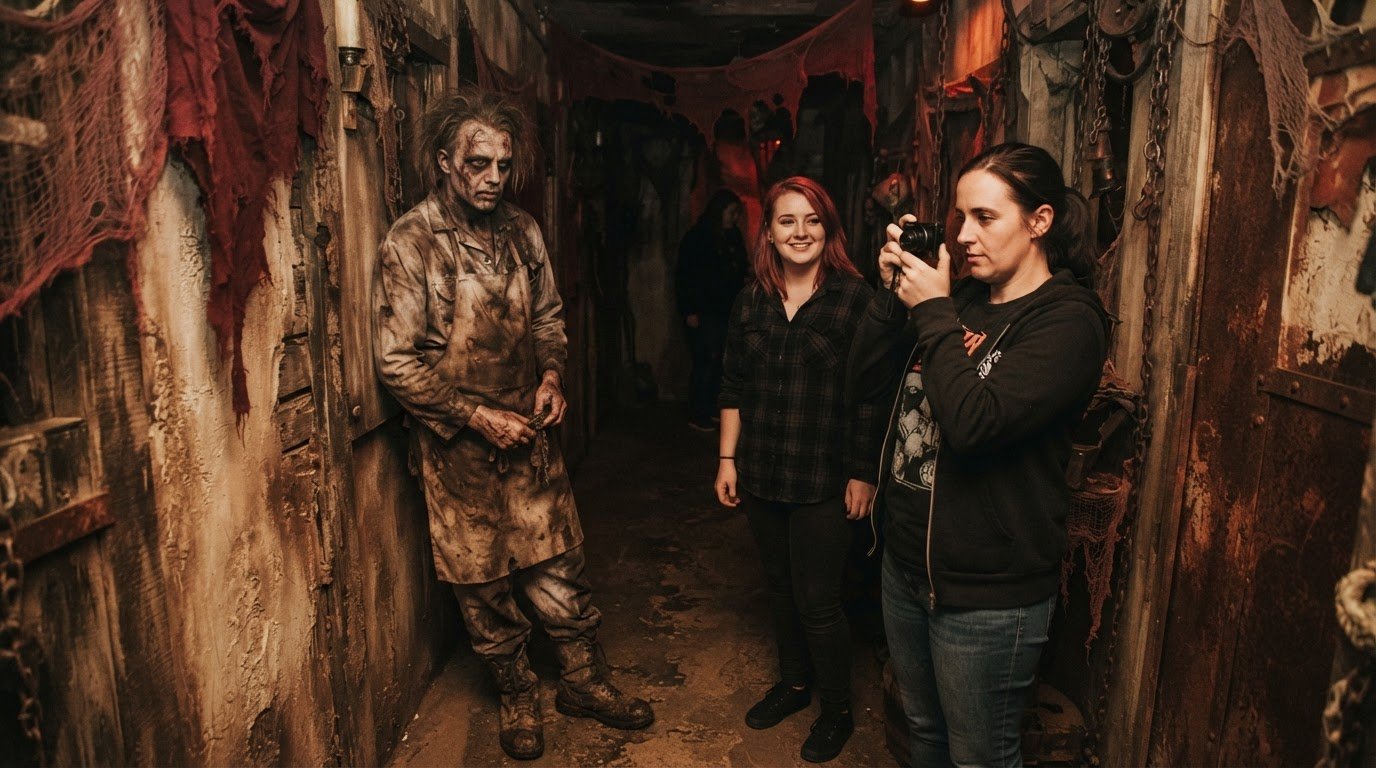
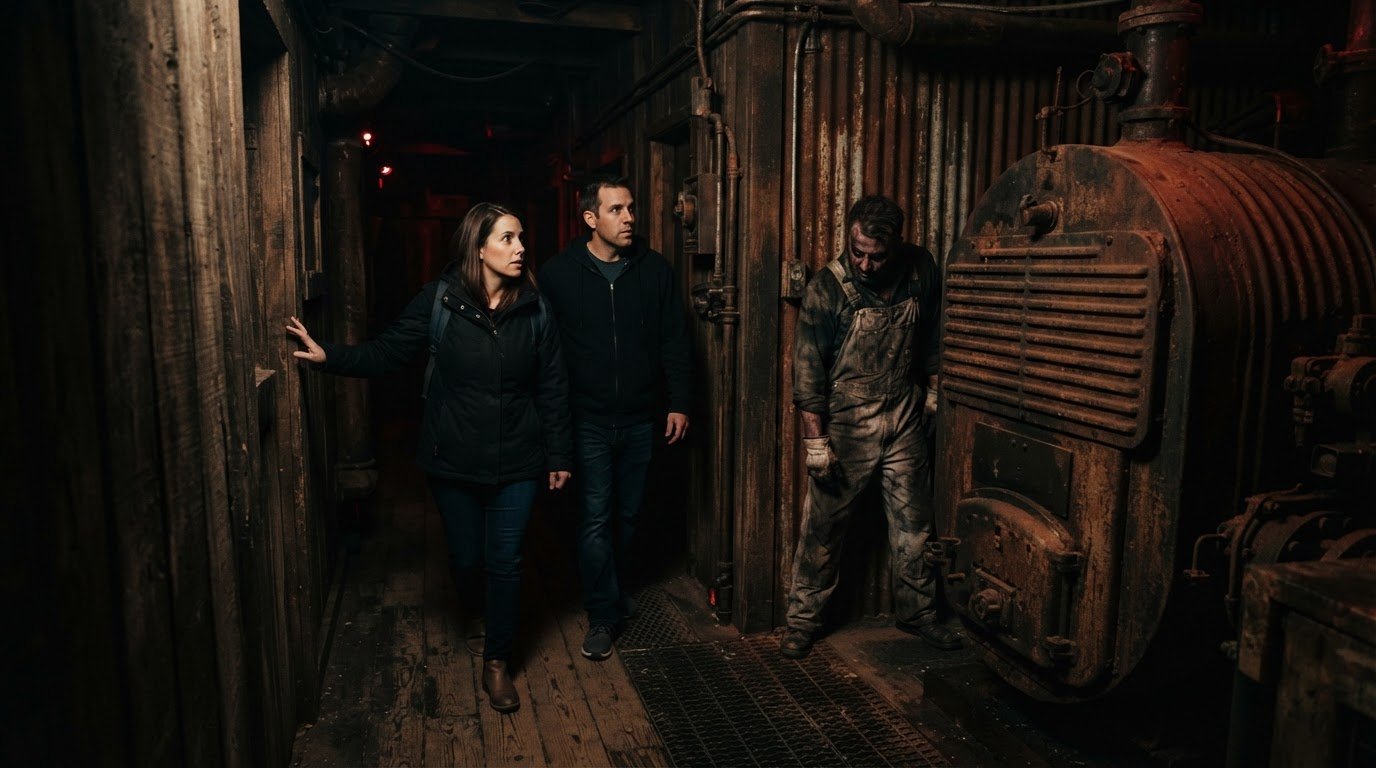
Dungeon of Doom Haunted House offers a different way to face fear: an immersive horror walkthrough located just a short drive from the Chicago area in Zion, Illinois. Its continuous walkthrough, professional-grade sets, and live actors create an intense encounter with the macabre, rather than a scheduled courage program or physical obstacle course.
If you want to test your nerves through atmosphere, performance, and suspense, explore General Admission, VIP, or Special Event tickets at Dungeon of Doom Haunted House. These ticket options are for the haunted-house experience, not the Chicago Celebration of Courage. The distinction helps you choose the kind of challenge you want: reflection and discussion, or a dark, theatrical encounter designed to provoke fear.
For questions about Dungeon of Doom Haunted House, contact the team.
Choose the Challenge You Want to Face
Courage isn’t a scoreboard. It’s a choice about what you’re willing to face and what kind of experience will make that choice meaningful. If you’re considering a test-your-courage challenge in Chicago, look beyond the dramatic name. Decide whether you want to test your nerves through atmosphere or reflect, speak, or act despite discomfort.
That distinction gives your next step purpose. Choose the kind of tension you want to face, then let the experience stand on its own terms. A frightening moment can stay with you long after the lights return. So can the decision to move toward it.
If a dark, immersive encounter feels like your kind of test, contact Dungeon of Doom Haunted House to start the conversation. Step forward with intention, and let your courage take shape in the experience you choose.
Frequently Asked Questions
What is the Test Your Courage Challenge in Chicago?
The Chicago event referred to here is the 2026 Celebration of Courage, a reception followed by a general program, not a documented obstacle-course competition. Its title signals a courage theme, but the event details identify no timed course or physical stations. For readers exploring a test-your-courage challenge in Chicago, that distinction matters: courage can involve emotional or social discomfort, not only physical trials.
Where is the Test Your Courage Challenge held in Chicago?
The event venue was the White City Ballroom at the Chicago Athletic Association, at 12 S Michigan Ave, Chicago, Illinois 60603. The ballroom is on the 8th floor. Use the full building address as the destination, then distinguish it from the room and floor where the Celebration of Courage program took place. This is a different event from the haunted-house experience in Zion, Illinois.
What are the dates and hours for the Chicago challenge?
The 2026 Celebration of Courage took place on June 11. Its VIP reception ran from 5:00pm to 6:00pm, followed by the general program from 6:00pm to 9:00pm. These are the hours for that past event, not upcoming dates. The reception and general program were separate schedule entries, so the time you needed depended on which portion you planned to attend.
How much do tickets cost, and are there age-based prices?
The event schedule doesn’t establish a ticket price or age-based rate, so don’t infer a dollar amount or child and adult pricing from its program format. The June 11, 2026 event has passed, making those rates inapplicable to registration for that date. The reception and general program describe parts of the event, not ticket categories or age-based discounts.
How do you register or buy tickets for the challenge?
Registration for the June 11, 2026 Celebration of Courage is no longer a next step because the event date has passed. Dungeon of Doom Haunted House tickets are for its separate haunted-house experience in Zion, Illinois, not for the Chicago program. Its ticket options include General Admission Tickets, VIP Tickets, and Special Event Tickets for that attraction.
How do you get to the venue, and what parking or public transit options are nearby?
Use 12 S Michigan Ave, Chicago, Illinois 60603, as the destination for route planning. Choose a route based on your starting point and travel mode.
Comments